

Understanding how blank guns work is important before buying or using one. Many beginners assume they are just toys because they do not fire a projectile. In reality, they function very similarly to real firearms, just without a bullet. This guide explains the full blank gun mechanism in simple and clear language.
How Does a Blank Gun Work?
If you’re wondering how blank guns work, the answer lies in its internal firing system. A blank gun is a firearm replica designed to fire blank cartridges. It contains the same major mechanical parts as a real handgun, including the slide, trigger, barrel, recoil spring, and magazine. The only major difference is the ammunition. Instead of live rounds, it uses blank cartridges that contain primer and gunpowder but no projectile.
Blank Gun Mechanism Explained (Step-by-Step)
Here is the blank gun working process in simple steps:
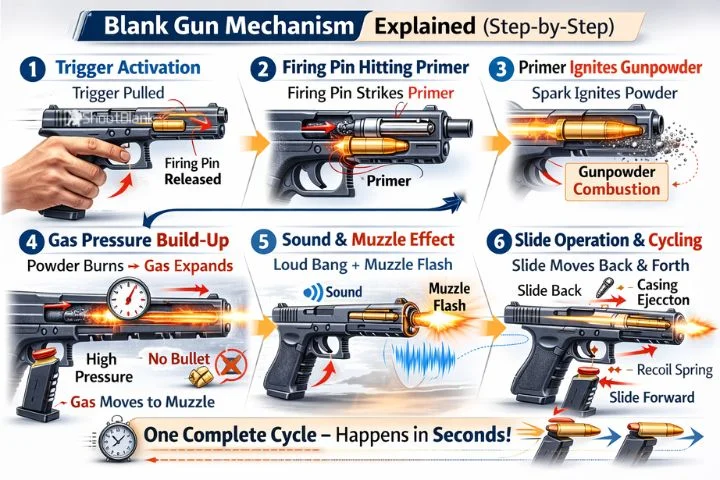
1. Trigger Activation
When you pull the trigger, it releases the firing pin.
2. Firing Pin Hitting Primer
The firing pin strikes the primer at the base of the blank cartridge.
3. Primer Ignites Gunpowder
The primer creates a spark that ignites the gunpowder inside the cartridge. This begins the gunpowder combustion in the blank gun.
4. Gas Pressure Build-Up
As the powder burns, gas pressure inside the blank gun increases rapidly. Since there is no bullet to travel forward, the expanding gas moves toward the muzzle or vent.
5. Sound and Muzzle Effect
The hot gas discharge creates a loud bang and visible muzzle flash. This is why blank guns feel realistic even without firing a projectile.
6. Slide Operation and Cycling
In semi automatic blank gun cycling systems, the gas pressure pushes the slide backward. This allows blank gun casing ejection from the chamber. The blank gun recoil spring then pushes the slide forward again, loading the next round.
This entire blank gun cycle process happens in a fraction of a second.
Blank Gun Components and Internal Parts
To fully understand the blank firing gun mechanism, it helps to know the main blank gun components:
- Barrel (Blocked Design): Prevents real bullets from passing through.
- Trigger Mechanism: Activates the firing system.
- Firing Pin: Strikes the primer.
- Slide: Moves backward and forward during cycling.
- Recoil System: Includes the blank gun recoil system and blank gun recoil spring.
- Magazine: Holds and feeds blank cartridges.
These blank gun internal parts work together to create a realistic firing experience.
Gas Pressure in Blank Guns
How Blank Guns Work Using Gas Pressure is the key force that drives everything. When the primer ignites the powder, pressure builds instantly inside the chamber. This pressure is responsible for:
- Producing the loud firing sound
- Creating the muzzle flash
- Operating the blank gun slide operation
- Enabling semi automatic blank guns to cycle properly
Without proper gas pressure, the blank gun working mechanism would not function correctly.
Blank Gun Primer and Gunpowder
A blank cartridge contains:
- Case
- Primer
- Gunpowder
There is no bullet. When the primer ignites the gunpowder, combustion produces expanding gas instead of propelling a projectile. This is the core principle behind how blank firing guns function.
How Blank Guns Work: Recoil System Explained
Yes, blank guns do produce recoil, although it is generally lighter than a real firearm. The blank gun recoil system works because gas pressure pushes the slide backward. This movement creates a recoil sensation similar to a live handgun.
The blank gun recoil spring then returns the slide forward, completing the cycle.
Why Are Blank Guns So Loud?

Many first-time users ask why are blank guns so loud when they don’t even fire a bullet. The answer is simple: the sound does not come from a projectile — it comes from rapidly expanding gas.
Understanding why blank guns are loud requires knowing what happens inside the chamber when the trigger is pulled.
How Blank Guns Make Noise
When a blank cartridge is fired, the primer ignites the gunpowder. This creates an instant explosion inside the chamber. Since there is no bullet blocking the front, all the energy turns into hot, expanding gas.
This hot gas discharge exits the barrel at extremely high speed. The sudden release of high pressure gas discharge creates a powerful pressure wave in blank guns. That pressure wave is what produces the blank gun loud bang people hear.
So if you’re wondering how blank gun noise works, it’s simply fast-expanding gas escaping in one sharp burst.
Blank Gun Sound Effect and Loud Retort
The blank gun sound effect is sharp, aggressive, and very similar to a real firearm. Many describe it as a blank gun loud retort because the noise is sudden and echoes strongly in open areas.
The loud bang is caused by:
- Rapid combustion of gunpowder
- Instant gas expansion
- High-speed gas release from the muzzle
Even without a projectile, the energy release is strong enough to create a realistic firing sound.
Muzzle Blast and Muzzle Flash
Another reason why blank pistol sound so loud is the visible and physical muzzle blast from blank gun discharge.
When the gas escapes:
- It produces a visible muzzle flash blank gun users can see
- It releases hot gas discharge from barrel
- It creates a shockwave in the surrounding air
The combination of muzzle flash and pressure wave makes the experience feel almost identical to a real handgun.
Why the Sound Feels So Real
The blank gun sound is not reduced just because there is no bullet. In fact, since all the energy converts into gas and sound instead of propelling a projectile, the blast remains extremely noticeable.
That’s why blank guns are often used for:
- Training simulations
- Film and stage effects
- Signaling purposes
The realistic muzzle flash, loud bang, and strong sound effect make blank guns highly convincing — even without firing a live round.
Main Components of a Blank Gun

To properly understand blank gun components, you need to look at both the firearm replica itself and the blank cartridge it uses. The system works as a combination of mechanical parts and specially designed blank ammunition.
Blank Gun Internal Parts
Most blank gun internal parts are very similar to a real handgun. These include:
- Barrel (Blocked Design) – A blank gun barrel blocked internally to prevent any real projectile from passing through. This blocked barrel blank gun design ensures it cannot fire live ammunition.
- Trigger Mechanism – The blank gun trigger mechanism releases the firing pin when pulled.
- Safety Lock – The blank gun safety lock prevents accidental discharge when engaged.
- Magazine – The blank gun magazine function is to store and feed blank cartridges into the chamber.
- Slide & Recoil System – Helps cycle the gun after each shot.
These blank gun components work together to create sound, flash, and realistic movement — even though there is no projectile fired.
What Is a Blank Cartridge?
Many people confuse blank bullets with real bullets, but there is a big difference.
A blank cartridge is a type of ammunition designed to create sound and muzzle flash without firing a projectile. Understanding blank cartridges explained properly requires knowing their structure.
Blank Cartridge Structure
The blank cartridge structure typically includes:
- Case – The outer shell that holds everything together
- Primer – Ignites when struck by the firing pin
- Gunpowder – The explosive material that creates pressure
- Crimped or Sealed Tip – Instead of a bullet
In a normal round, you have case, primer, gunpowder, and bullet. The key difference between bullet and cartridge is that the bullet is just the projectile, while the cartridge includes all components together.
In blank ammunition, there is no projectile. Instead, the top is sealed in one of the following ways:
- Crimped blank cartridge (folded tip)
- Sealed blank cartridge
- Crimped blank tip
- Sealed blank tip
- Wad in blank cartridge (paper or plastic seal)
This is why blank ammo explained simply means: primer and gunpowder without a bullet.
How Blank Cartridges Work
Blank cartridge working is based on pressure. When the firing pin hits the primer, it ignites the gunpowder. The burning powder creates high-pressure gas inside the chamber.
Since there is no projectile, the gas moves forward and exits the barrel, producing a loud bang and muzzle flash. This is how blank cartridges work and why they still sound powerful despite having no projectile.
Blank Pistol Ammo and Blank Bullets
The term blank pistol ammo or blank bullets is commonly used, but technically they contain no bullet at all. They are designed only to produce sound, flash, and cycling action in a blank gun.
So in simple terms:
- Blank ammunition = case + primer + gunpowder
- No projectile
- Crimped or sealed top
- Designed for noise and visual effect
Together, the blank gun internal parts and blank cartridge components form a safe but realistic system that mimics a real firearm without firing live ammunition.
Can a Blank Gun Shoot Real Bullets?

One of the most common questions buyers ask is: can a blank gun shoot real bullets? The simple and clear answer is no.
A blank gun is specifically engineered to fire blank cartridges only. It is not built to handle live ammunition, and attempting to use real ammo in a blank gun is extremely dangerous.
Can Real Ammo Be Used in a Blank Gun?
No, real ammo cannot be safely used in a blank gun. Blank guns are manufactured differently from real firearms. The biggest reason is the blocked barrel blank gun design.
The barrel is internally restricted, meaning a projectile cannot pass through it. This built-in obstruction ensures the gun cannot fire real bullets under normal conditions.
Difference Between Blank Gun and Real Gun
Understanding the difference between blank gun and real gun is important:
- A real firearm is designed to fire live ammunition with a projectile.
- A blank gun is designed to create sound and flash only.
- Real firearms use fully open barrels.
- Blank guns use blocked barrels for safety.
Although blank gun vs real firearm comparison shows many visual similarities, their internal construction and purpose are very different.
Real Firearm Feel Without Live Ammunition
Blank guns are popular because they provide a realistic handling experience and real firearm feel. They produce sound, slide movement, and recoil-like action. However, this does not mean they function like real guns internally.
They are not built to withstand the pressure generated by live ammunition.
Why Modification Is Dangerous
Some people ask whether modification can allow a blank gun to fire real bullets. Any attempt to alter the barrel or internal structure is extremely risky.
Modification dangerous outcomes include:
- Explosion due to pressure buildup
- Severe injury or death
- Permanent damage to the firearm
- Serious legal consequences
In many regions, attempting such modification is illegal South Africa and can lead to criminal charges.
Can a Blank Gun Kill Someone?

A common question many people ask is: can a blank gun kill someone? While blank guns do not fire a projectile, they are not completely harmless. In certain situations, especially at very close range, they can cause serious injury and in rare cases may be fatal.
Are Blank Guns Dangerous?
Yes, blank guns can be dangerous if misused. Although they do not discharge a bullet, they still produce powerful gas pressure, heat, and a shockwave when fired. Many people underestimate blank gun safety risks because there is no projectile involved.
Can Blank Guns Cause Injury?
The answer is yes — blank guns can cause injury, particularly at close range. When fired, hot gas discharge exits the barrel at high speed. This creates a strong pressure wave and muzzle blast.
The blank gun close range danger comes from:
- High-pressure gas
- Burning particles
- Possible wad or sealing material discharge
These factors can lead to blank gun close range injury if the muzzle is pointed at someone nearby.
Blank Gun Damage at Close Range
Blank gun damage at close range can include:
- Burns from hot gas discharge
- Skin penetration from debris or wadding
- Hearing damage
- Eye injuries
In extreme close-contact situations, blank gun penetrating wounds have been reported due to the intense muzzle blast injury risk.
Explore Related Guides & Products:

2 Comments
Bro stop with the shitty inaccurate Ai slop images. You are clogging up Google images with garbage
Thanks for the feedback, bro. We’ll try to use more real images next time.